
How InvoiceYou's e-invoice export is validated
Specific tools, specific rule sets, and the limits of what a passing result proves. This is validation evidence, not certification or a promise of legal compliance.
Latest recorded results
InvoiceYou exports a hybrid PDF/XML file using the
Factur-X Basic profile, specification identifier
urn:cen.eu:en16931:2017#compliant#urn:factur-x.eu:1p0:basic.
The same format family is called ZUGFeRD in Germany.
| Check | Date | Profile / rules | Result |
|---|---|---|---|
| FNFE-MPE validation service | 28 July 2026 | Factur-X Basic | Fully valid |
| veraPDF | 28 July 2026 | PDF/A-3B | Passed |
| KoSIT Validation Tool | 28 July 2026 | Factur-X 1.07.2 Basic, CII D22B | Passed |
These are checks of a generated test artefact and the current exporter source. They do not certify InvoiceYou, approve it on behalf of any authority, or guarantee that every future file will be factually or legally correct.
FNFE-MPE manual check
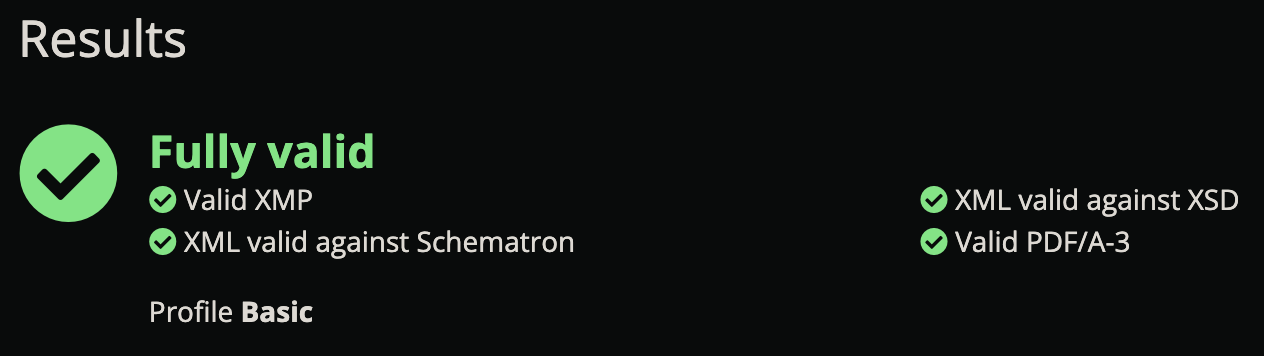
A Factur-X Basic PDF generated by InvoiceYou was submitted to the FNFE-MPE validation service. Its result screen reported Fully valid and confirmed all four checks exposed by the service:
- Valid XMP metadata
- XML valid against the XSD
- XML valid against the Schematron rules
- Valid PDF/A-3 container
Automated KoSIT test
InvoiceYou's C++ exporter repository contains an end-to-end test that creates a synthetic
invoice, exports the hybrid PDF, validates the PDF/A-3B container with veraPDF, extracts
factur-x.xml, and then runs that XML through the KoSIT validation engine.
| KoSIT engine | Validation Tool 1.5.0 |
|---|---|
| Scenario | ZUGFeRD 2.3.2/Factur-X 1.07.2 - Basic |
| Syntax | UN/CEFACT CII D22B |
| Rule checks | Factur-X 1.07.2 Basic XSD and Schematron |
| Exporter source revision | aad92d4 |
| Test result | 13 assertions passed on 28 July 2026 |
KoSIT provides the validation engine; the applicable rules come from the separate scenario configuration. The configuration used here identifies the Basic profile from the invoice's specification ID, then applies its Factur-X XSD and Schematron resources. A non-zero validator exit status fails the automated test.
What the results do and do not prove
| The checks support | The checks do not establish |
|---|---|
| The PDF/A-3 container and XMP metadata are structurally valid | That the invoice describes a real transaction accurately |
| The embedded XML matches the tested Basic XSD | That the VAT treatment or other tax decisions are correct |
| The XML passes the tested Basic Schematron business rules | That every recipient or platform will accept the file |
| The PDF and XML can form a valid Factur-X Basic document | Certification, authority approval, XRechnung support, or complete legal compliance |
Important limitation for France
Basic validation is not the French reform profile
InvoiceYou currently exports Factur-X Basic. France's current reform specification describes the minimum exchange base using the EN16931 and EXTENDED-CTC-FR profiles. It lists Basic as an additional Factur-X profile, not as one of those minimum-base reform profiles.
Therefore, the results above establish format-level Basic validation. They do not establish that InvoiceYou's current export satisfies France's 2026 reform profile requirements. France also requires covered invoices to be exchanged through a state-approved platform, which InvoiceYou does not connect to.
See the French tax authority's current specifications and standards and its explanation of approved platforms. Ask your platform or accountant which profile and workflow your transaction requires.
When the checks are repeated
The automated exporter test should be rebuilt and rerun whenever invoice XML generation, calculations, PDF embedding, profile identifiers, schemas or validation rules change. A fresh manual FNFE-MPE check should accompany changes that affect the final exported PDF. UI-only app releases do not require a new validation record when the exporter is unchanged.